

SPEC BRIEFS
Nylon Patch vs. Chemical Pre-Applied Threadlocker: Which Is Right for Your Application?
Key Takeaways:
- Both types are applied at a service center before assembly: neither requires on-line liquid dispensing
- Chemical pre-applied uses microencapsulated anaerobic adhesive: high break torque, single use, rated to 400 degrees Fahrenheit
- Nylon patch locks through mechanical thread interference: no cure time, reusable up to 5 cycles, produces no outgassing
- Chemical for permanent, high-load, or fluid-sealing joints; nylon patch for serviceable, electronics, or high-throughput assemblies
- NSF/UL-approved grades exist for chemical pre-applied in potable water applications; no nylon patch equivalent
- Bradley applies both types and can specify a combination within the same production order
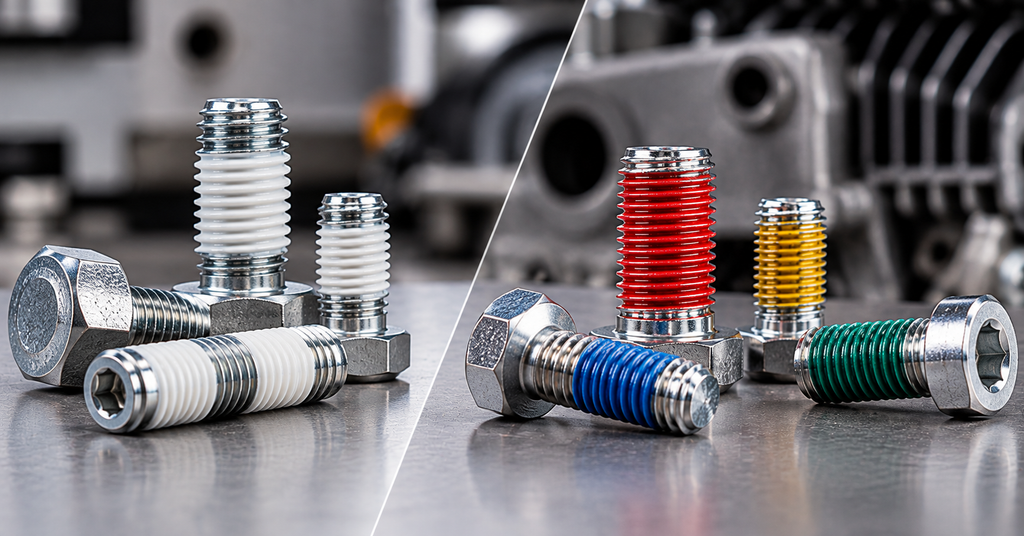
Chemical pre-applied threadlocker is the right specification when the joint is permanent, high-load, operates above 250 degrees Fahrenheit, or requires sealing. Nylon patch is correct when the joint will be serviced in the field, when outgassing is a concern, or when your assembly line cannot wait for cure time.
Both types arrive on the fastener dry-to-touch, eliminate on-line liquid dispensing, and activate at installation. The decision is not about which is better overall. It is about what the joint demands after it is assembled.
Because Bradley Group of Companies applies both chemical and nylon patch coatings, this is the only objective comparison of its kind. No product preference. No brand agenda.
Two Technologies, Two Fundamentally Different Mechanisms
Because Bradley Group of Companies applies both chemical and nylon patch coatings, this is the only objective comparison of its kind. No product preference. No brand agenda.
Understanding why these two coating types behave differently in service starts with how they work, which is about as different as two pre-applied coatings can be.
Chemical pre-applied coatings, including the Loctite DRI-LOC family applied by Bradley, use microencapsulated anaerobic adhesive applied as a dry film. In storage and transit the coating is completely inert. When the fastener is installed, thread engagement crushes the capsules, releases the resin, and the anaerobic environment triggers polymerization. The result is a rigid thermoset bond that fills thread voids, locks the joint, and seals against fluid ingress and corrosion. Fixture strength is reached in approximately 15 minutes. Full cure completes within 24 hours.
Nylon patch coatings fuse a thermoplastic nylon element directly to a defined section of the thread. No adhesive, no chemical reaction, no cure time. When the fastener is installed, thread compression generates prevailing torque through interference: the joint is locked the moment installation is complete. The Bradley nylon patch does not outgas, making it the correct specification for sealed electronics, optical enclosures, and any assembly where chemical vapors would contaminate adjacent components. It is reusable up to five cycles with diminishing prevailing torque on each removal.
For full mechanism detail on both types, see: Pre-Applied Thread Locking Compounds: What They Are, How They Work, and Why OEMs Use Them
Head-to-Head: 8 Variables That Matter in Specification
No single variable determines the right coating. The decision sits at the intersection of joint requirements, operating environment, and downstream service expectations. Here is how chemical and nylon patch compare across the variables that matter most.
| Variable | Chemical Pre-Applied | Nylon Patch |
|---|---|---|
| Locking mechanism | Anaerobic chemical bond | Mechanical thread interference |
| Break torque | High | Moderate |
| Activation / cure | 15-min fixture; 24-hr full cure | Instant: no cure required |
| Reusability | Single use | Up to 5 cycles |
| Temperature range | Up to 400°F (high-temp grades) | Up to ~250°F |
| Outgassing | Yes: vapors during cure | None |
| Substrate compatibility | Requires active metal; primer for aluminum/stainless | Substrate-independent |
| NSF / potable water | Yes: DRI-LOC 204, Loctite 513 | No |
Two variables carry the most direct consequence for warranty exposure: locking strength and outgassing. Chemical pre-applied achieves break torque values that nylon patch cannot match, and for structural or vibration-critical joints that strength differential is the specification. For electronics and optical assemblies, the issue is not strength but contamination, and nylon patch is the only option that produces none.
When to Specify Chemical Pre-Applied
Chemical is the correct specification when the joint is permanent, carries a structural load, operates at elevated temperature, or needs to seal against fluid ingress.
High-vibration, permanent joints. Engine block fasteners, powertrain hardware, and chassis mounting all qualify. Small engine OEMs like Kohler and Toro specify chemical pre-applied on engine fasteners because those joints run at 3,600 RPM under continuous load and in-field loosening generates direct warranty exposure. Bonded performance is required; mechanical friction alone is not sufficient for those conditions.
Thread sealing required. Chemical coatings fill the thread interface completely, blocking fluid migration that a mechanical patch cannot prevent. Hydraulic systems, fluid-carrying assemblies, and potable water fittings require this. DRI-LOC 204 and Loctite 513 carry UL approval specifically for potable water applications.
Operating temperature above 250 degrees Fahrenheit. Standard grades hold to 300 degrees; high-temp formulations to 400 degrees. No nylon patch grade performs above 250 degrees, making chemical the only pre-applied option for fasteners adjacent to combustion or exhaust sources.
Single-use production assemblies. When a fastener is installed at the factory and never intended for field removal, chemical is the stronger specification. The single-use characteristic is not a limitation in a permanent assembly.
When to Specify Nylon Patch
Nylon patch is correct when the joint will be accessed in service, when the operating environment is sensitive to chemical vapors, or when the assembly line cannot tolerate a cure wait.
Serviceable joints. Any fastener a technician or end user will remove and reinstall in the normal course of maintenance belongs here. Polaris powersports platforms and Mercury Marine outboard engines are routinely serviced by dealers and end users in the field. Nylon patch supports five disassembly cycles without replacing the fastener, which matters when blade changes, filter services, and routine maintenance are part of the product’s expected use.
Electronics and optical assemblies. Nylon patch produces no outgassing. Chemical adhesive vapors inside a sealed housing can fog a lens, contaminate a sensor, or compromise a circuit board. For these assemblies, nylon patch is not simply preferred; it is the only appropriate pre-applied option.
Zero cure time required. On high-throughput automated lines where a 15-minute fixture wait creates a bottleneck, nylon patch locks the joint on installation and the line continues without pause.
Operating temperature below 250 degrees Fahrenheit. Most appliance, recreational, and light industrial OEM applications fall within this range. Where temperature is not a constraint, nylon patch serviceability often tips the decision.
How to Choose: 5 Questions
Work through these in order. They resolve the specification for the majority of applications. For edge cases, Bradley’s technical team is available before production volume is committed.
- 1. Will this joint be disassembled in service? Yes: nylon patch. No: chemical.
- 2. Operating temperature above 250 degrees Fahrenheit? Yes: chemical required.
- 3. Outgassing a concern? Electronics, optics, sealed enclosures: nylon patch only.
- 4. Sealing required? Fluid systems, potable water: chemical only.
- 5. NSF or potable water compliance needed? Chemical only: DRI-LOC 204 or Loctite 513.
Some assemblies require both. Chemical on structural, permanent fasteners and nylon patch on serviceable access hardware can be specified within the same production order. Bradley applies both coating types, and the logistics do not change.
The choice between chemical pre-applied and nylon patch is an engineering specification decision made joint by joint, based on load, temperature, serviceability, and operating environment. Chemical wins when the joint is permanent, high-load, elevated-temperature, or requires sealing. Nylon patch wins when the joint will be serviced, when outgassing is a concern, or when zero cure time is a throughput requirement.
Bradley Group of Companies has applied both coating types for more than 40 years. The sample program, up to 100 pieces at no charge, exists to confirm the right coating on the right fastener before production volume is committed.
Reach us by filling out our form, or call 630-443-8424.