

SPEC BRIEFS
How to Choose the Right Pre-Applied Threadlocker Grade: A Specification Guide for OEM Engineers
Key Takeaways:
- Pre-applied coating grade selection is specified by product number and application profile, not color alone.
- The five selection variables are: fastener size, substrate and plating, required locking strength, operating temperature, and disassembly requirement.
- DRI-LOC 200/201 (yellow) covers most high-volume OEM production fasteners; 203 (silver) is required above 300 degrees Fahrenheit.
- DRI-LOC 202 (green) is the correct grade for zinc, nickel, or chrome-plated fasteners where standard grades underperform.
- DRI-LOC 204 (red) is a permanent high-strength sealing grade; 2045 (pink) is the oil-tolerant alternative for contaminated substrates.
- Bradley applies all DRI-LOC grades plus Precote 80 and 85 for European OEM specifications; samples available at no charge.
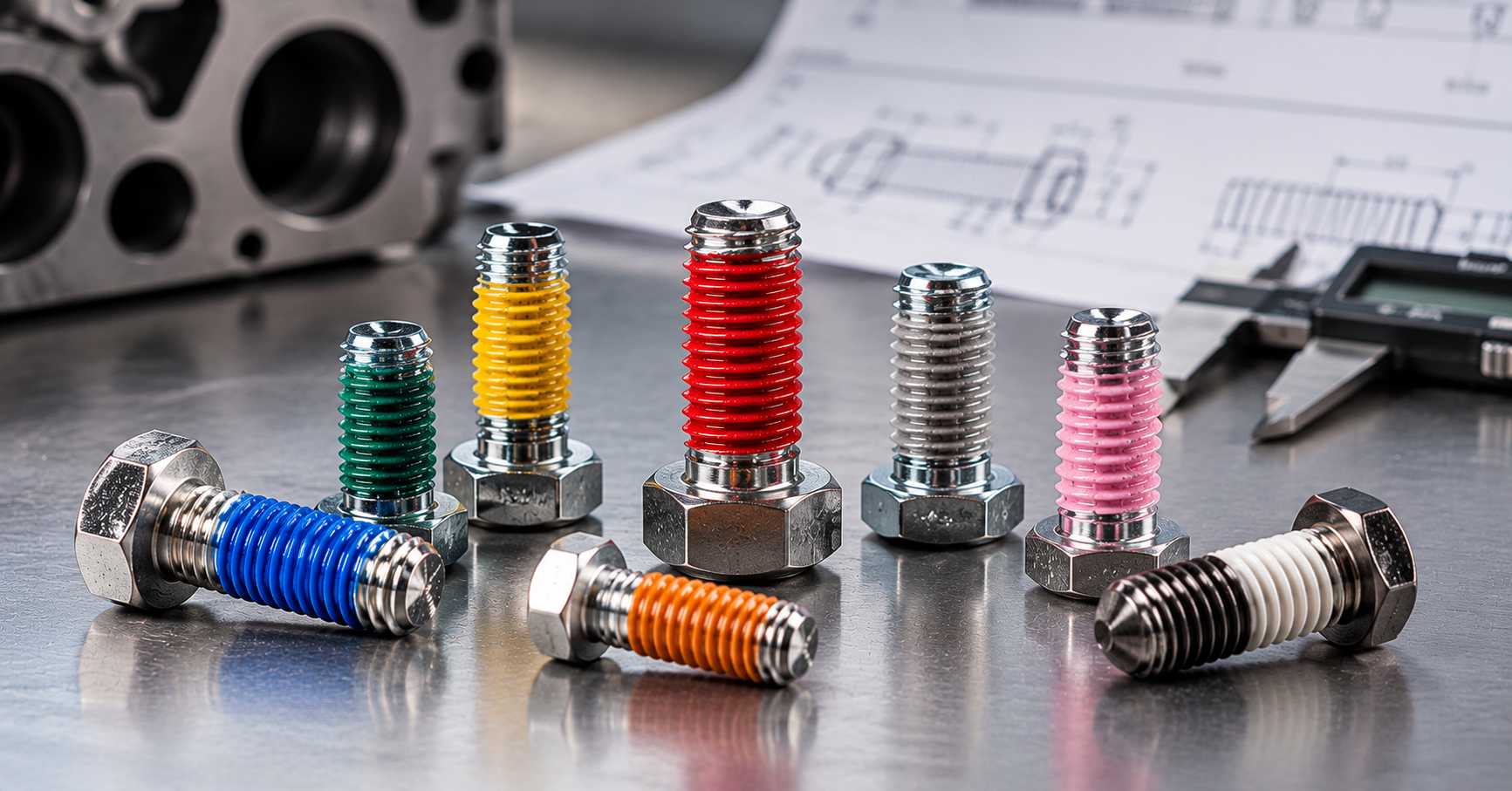
Grade selection for pre-applied threadlocker coatings comes down to five variables: fastener size, substrate material and plating, required locking strength, operating temperature, and whether the joint will ever be disassembled in service. Get those five right and the correct DRI-LOC grade follows directly.
What most engineers searching for threadlocker guidance find online is a DIY liquid color guide: red is permanent, blue is medium, green wicks into assembled joints. That system does not translate to pre-applied coating specification. The DRI-LOC product family uses its own grade and color system, optimized for factory-applied coatings on OEM fastener lines. This guide maps it.
Why Pre-Applied Grade Selection Is Different
Liquid threadlocker is applied to one fastener at a time at the point of assembly. The engineer chooses a product from a limited color range based on general strength requirements. Consistency depends on who applies it and how much.
Pre-applied coatings are specified at the engineering stage and applied in a controlled process to every fastener in the lot. The grade must account for substrate reactivity, plating interaction, operating temperature at the joint level, and production torque specifications. A grade that performs on bare steel may underperform on zinc-plated fasteners. A grade rated to 300 degrees Fahrenheit fails on an engine-block fastener that sees 375 degrees in service. The DRI-LOC system gives engineers the precision to match the coating to those variables, not just to a general strength preference.
The DRI-LOC Grade Guide
Bradley applies the full DRI-LOC product family plus Precote 80 and 85 for European OEM specifications. The table below maps each grade to its performance profile and primary application.
| Product | Color | Strength | Temperature Range | Best For |
|---|---|---|---|---|
| 200/201 | Yellow | High | Up to 400°F | Standard OEM production; high-volume engine and chassis fasteners |
| 202 | Green | Medium | Up to 300°F | Plated fasteners (zinc, nickel); torque-sensitive applications |
| 204 | Red | High + sealing | Up to 300°F | Permanent joints; fluid-adjacent fasteners; vibration-critical assemblies |
| 2045 | Pink | Medium-high | Up to 300°F | Oil-contaminated or hard-to-clean substrates; flexible OEM spec |
| 205 | Light Orange | Medium (lubricated) | Up to 300°F | Fine thread fasteners; precision assemblies; reduced install torque |
| STS | Light Blue | Sealing only | Up to 300°F | Straight thread fittings; hydraulic and pneumatic connections |
The Five Selection Variables
Each variable narrows the grade selection. Work through them in order and the correct product becomes clear.
Fastener size. Larger fasteners require greater coating coverage and higher locking torque. DRI-LOC 200/201 covers M6 through M20 and larger inch-series fasteners. Fine-thread and small-diameter fasteners below M6 should be evaluated with 205 to avoid galling during installation.
Substrate and plating. Bare steel and cast iron are highly reactive and work well with all DRI-LOC grades. Zinc, nickel, and chrome plating reduce surface reactivity. Specify DRI-LOC 202 for plated fasteners to maintain consistent performance. Stainless steel and aluminum require a primer activator applied before coating.
Required locking strength. Match break torque requirements to the grade. DRI-LOC 200/201 and 204 deliver the highest break torque values. DRI-LOC 202 and 2045 are medium-strength grades. Review IFI-124 and IFI-524 test data for the specific fastener diameter before finalizing the specification.
Operating temperature. Standard DRI-LOC grades perform to 300 degrees Fahrenheit in continuous service. DRI-LOC 201 and 203 are rated to 400 degrees Fahrenheit. For any fastener within 6 inches of a combustion or exhaust source, verify the peak operating temperature before selecting a standard-grade product.
Disassembly requirement. Pre-applied chemical coatings are single-use. If a fastener will be removed for service, specify the nylon patch instead of a chemical grade. If the joint is permanent, specify the highest locking strength that matches the other variables.
Grade Selection by Application Type
The table below maps common OEM production scenarios to the recommended DRI-LOC grade and the reasoning behind each selection.
| Application | Recommended Grade | Why |
|---|---|---|
| Small engine fasteners | 200/201 or 203 | High locking strength; 203 where temp exceeds 300°F at the joint |
| Plated production fasteners | 202 | Lubricated formula corrects for reduced surface reactivity on plated parts |
| Permanent structural joints | 204 | Highest break torque; fluid sealing where needed alongside locking |
| Oil-exposed or contaminated surfaces | 2045 | Surface-tolerant formula maintains performance without aggressive cleaning |
| Fine thread / precision hardware | 205 | Reduced installation torque prevents galling on small-diameter threads |
| Straight thread fittings / hydraulics | STS | Sealing function only; not a threadlocker for rotational load applications |
| European drivetrain specifications | Precote 80/85 | Meets European OEM specifications where DRI-LOC is not print-specified |
A Note on Liquid Threadlocker Equivalents
Engineers transitioning from liquid threadlocker specifications often ask how DRI-LOC grades map to the liquid products already in their engineering records. The crossover is not exact because pre-applied coatings are formulated for factory application rather than on-line dispensing. As a general reference:
DRI-LOC 2045 is the pre-applied equivalent of medium-strength liquid formulations in the Loctite 242/243 range. It is the most commonly specified grade for standard production fasteners.
DRI-LOC 204 Red maps to high-strength liquid grades in the Loctite 262/271 range. Permanent assemblies, permanent specification.
DRI-LOC 200/201 covers applications where the print spec calls for a general-purpose high-locking compound without the full permanence of 204.
DRI-LOC STS replaces liquid thread sealants in the Loctite 569/577 range for straight thread fitting applications. It seals; it does not lock.
Bradley’s technical team can cross-reference any existing liquid specification and confirm the correct DRI-LOC grade for the pre-applied equivalent.
The Bottom Line
Pre-applied threadlocker grade selection is an engineering decision, not a color choice. The right grade depends on the fastener’s substrate, the temperature at the joint, the locking strength required, and whether the assembly will ever come apart. Match those variables to the DRI-LOC grade guide above and the specification follows directly.
If the application has edge cases, Bradley’s technical team is available to review the specification before production starts. The sample program exists to confirm the right call before lot quantities are committed.
Not sure which grade is right? Bradley’s technical team will match the coating to your application. Sample program: up to 100 pieces at no charge. Quotes returned within one business day. Reach us at bradleygoc.com or call 630-443-8424.